
Think routines kill puppy fun? Think again.
A steady daily schedule is the quickest way to teach potty, sleep, and manners while keeping your home sane.
This post gives a ready-to-use, hour-by-hour blueprint you can print, tweak, and stick on the fridge.
You’ll get clear meal times, potty windows, nap blocks, short training moments, and simple tips to shift timing by age and size.
Follow this plan and you’ll see fewer accidents, calmer naps, and faster learning within weeks.
Sample Daily Puppy Schedule (Start Here)

Think of this as your working blueprint. The hour by hour framework you can print, tweak, and stick to the fridge until it becomes muscle memory. It covers everything: potty breaks, feeding windows, naps, crate time, training moments, play bursts, and those calm enrichment periods that help a puppy settle, learn, and actually feel secure in a new home.
• 6:00 AM – Wake up, immediate potty break outside
• 6:15 AM – Breakfast in crate or quiet pen, leave food down for 15 minutes
• 6:35 AM – Potty break
• 6:45–7:00 AM – Short training session or calm indoor play (5–10 minutes)
• 7:10 AM – Potty break, then crate time with a chew toy
• 7:30–9:30 AM – Nap (you can stretch this if your pup sleeps longer)
• 9:30 AM – Potty break, then light play or short walk if vaccinated (10–15 minutes)
• 10:00 AM – Potty break, then independent enrichment (snuffle mat, frozen Kong, puzzle toy)
• 10:30 AM–12:00 PM – Nap in crate or pen
• 12:00 PM – Potty break, then lunch (leave down 15 minutes)
• 12:20 PM – Potty break
• 12:30–2:30 PM – Nap or quiet crate time
• 2:30 PM – Potty break, short training session or gentle play (5–10 minutes)
• 3:00–5:00 PM – Supervised downtime, potty break at 4:00 PM, light socialization exposure (sounds, textures, gentle handling)
• 5:30 PM – Potty break, then dinner (leave down 15 minutes)
• 5:50 PM – Potty break
• 6:00–7:00 PM – Supervised family time, short training session, calm play
• 7:15 PM – Potty break, then crate or pen with calming chew
• 8:00–9:30 PM – Final nap or quiet time
• 9:30 PM – Last potty break before bed
• 10:00 PM – Into crate for overnight sleep
Every puppy’s different. A larger breed might hold their bladder longer, a tiny breed might need an extra mid morning trip, and some pups crash hard after breakfast while others stay alert until noon. This schedule gives you the rhythm. Watch your puppy’s signals and shift the timing by 15 or 30 minutes as needed.
Feeding Guidelines for Routine Building

Most young puppies eat three to four meals per day, spaced about four to five hours apart. Consistent meal timing anchors everything because food moves through a puppy’s system on a predictable schedule. That means potty breaks become predictable too.
Feed at the same times every day, ideally synced with your own mealtimes so you’re around to supervise and respond when the pup needs to go outside. Measure portions according to the food package or your vet’s guidance and leave the bowl down for exactly 15 minutes. If your puppy walks away or doesn’t finish, pick up the bowl anyway. Grazing throws off potty timing and makes house training harder.
Within 20 to 30 minutes after eating, most puppies need to poop. Some go right away, some take a full half hour. Track your pup’s pattern for a few days. Breakfast at 6:15 means potty around 6:35 and often again closer to 7:00. You’ll quickly learn the window that matters for your dog.
- Stick to the same meal times every single day, even weekends. Consistency teaches the body when to expect fuel and when to eliminate.
- Use a quiet, low distraction spot for feeding. A crate or pen works well. The pup eats calmly and you control the environment.
- Adjust portion size as your puppy grows, not meal frequency. Most pups stay on three meals until around six months, then drop to two.
- Link every meal to an immediate potty trip and a second trip 20 to 30 minutes later. That double check prevents accidents and speeds up house training.
Potty Training and Break Intervals
A rough guideline says a puppy can hold their bladder for about one hour per month of age. So a two month old might manage two hours during the day and a three month old closer to three. That’s the maximum, not the target.
In practice, plan potty breaks every one to two hours while your puppy’s awake, and always immediately after waking, eating, playing, or training. Watch for circling, sniffing the floor, whining, or moving toward the door. Those signals mean the pup needs to go now. The more often you catch the moment and get outside in time, the faster the pup learns where elimination belongs.
If you’re working from home, set a timer on your phone so you don’t lose track during a meeting or meal prep. Consistency shrinks the learning curve. Take the pup to the same outdoor spot every time, use a short cue word like “Go potty” while they’re in the act, and reward with calm praise or a tiny treat the instant they finish.
Keep the trip quick and boring. This is work, not playtime, so the pup learns the purpose of going outside. If you stay predictable about timing, location, and response, most puppies show clear progress within two to three weeks and reliable habits by four to five months. Small breeds and certain individuals take longer.
Puppy Sleep and Nap Structure

Young puppies sleep somewhere between 16 and 20 hours per day. That sounds like a lot until you realize how much energy they burn learning, growing, and navigating a brand new world. Without enough sleep, puppies become cranky, mouthy, overstimulated, and harder to train. Just like an overtired toddler who melts down before bedtime.
Schedule naps the same way you schedule meals. After every active period (breakfast and potty followed by ten minutes of training), the pup should settle into a crate or pen with a safe chew toy and nap for one to two hours. Mid morning nap, early afternoon nap, late afternoon rest, and a longer overnight sleep create the rhythm that keeps behavior steady.
Use a quiet, dim room and resist the urge to let kids or other pets disturb the pup while they’re resting. A crate with a soft blanket or a pen with a cozy bed works well because the confined space signals it’s time to power down.
Exercise and Play Planning

Puppies need movement and mental stimulation, but not as much as most new owners think. Too much exercise (long hikes, repetitive fetch for 40 minutes, sustained running beside a bike) damages growing bones and joints and creates an overstimulated, hyperaroused pup who can’t settle.
The general rule is about five minutes of structured, higher energy exercise per month of age, per day. A three month old gets roughly 15 minutes of active play or a short walk, split into two or three sessions if that feels more manageable. Focus on low impact activities that build coordination and confidence without stressing developing joints.
Short indoor games, gentle tug with a soft toy, a few minutes of fetch in the hallway, or a slow walk around the block if vaccinations are complete all count. Always supervise play with other dogs and stop before your puppy gets overly wound up or starts nipping and jumping uncontrollably.
• Indoor scent games: Hide a few treats around one room and let the pup sniff them out. Great for rainy days and mental tiredness.
• Gentle tug: Use a soft rope toy, let the pup win sometimes, and practice “drop it” to keep the game polite.
• Short leash walks: Ten minutes around the neighborhood, focusing on loose leash practice and calm sniffing.
• Puppy safe obstacle course: Couch cushions on the floor, a cardboard box tunnel, a low step to climb. All build body awareness.
• Supervised play with a calm adult dog: Brief, five minute sessions teach social cues and bite inhibition without overwhelming the pup.
Integrating Crate Time Into the Routine

A crate serves as a den. A safe, enclosed space where a puppy can rest without decisions or distractions. It supports house training because dogs instinctively avoid soiling their sleeping area, and it gives you a way to manage the pup when you can’t watch closely (during your own meals, work calls, or when you need to shower and get dressed).
Introduce the crate with positive associations from day one. Feed meals inside, toss treats in randomly throughout the day, and never use the crate as punishment. Start with short sessions (ten minutes while you’re in the same room) and gradually extend the duration as the pup learns that crate time predicts calm, rest, and safety. Most puppies settle into a nap within five to ten minutes if they’ve had a potty break, a bit of activity, and a chew toy to occupy their mouth.
For very young puppies, crate sessions during the day might last one to two hours, matching a nap cycle. Overnight, many pups can hold it longer (four to six hours by three months), but expect at least one middle of the night potty trip in the first few weeks.
Keep nighttime exits quick, quiet, and boring. Carry or walk the pup straight outside, let them go, then return them to the crate without play or prolonged interaction. The goal is to teach that nighttime is for sleeping, not for starting the day.
Socialization Planning and Routine Integration

The critical socialization window runs roughly from 8 to 16 weeks. The period when puppies are most open to new experiences and least likely to develop lasting fear. What a puppy encounters calmly during this time (sounds, surfaces, people, other animals, handling, car rides) usually becomes normal and unremarkable for life.
Build short, positive exposures into your daily schedule rather than saving socialization for weekends or special outings. A few minutes of gentle handling during morning playtime, running a vacuum in another room while the pup chews a Kong at lunch, a five minute visit from a calm friend in the evening. All count.
The key is keeping each exposure brief, positive, and well within the pup’s comfort zone. If the puppy looks scared, whines, or tries to hide, you’ve pushed too far. Back up, create more distance or lower the intensity, and let the pup observe from safety until they relax.
• Household sounds: Dishwasher, doorbell, phone ringing, TV, washing machine, blender (start at low volume, pair with treats).
• Different surfaces: Carpet, tile, grass, gravel, wood floors, a wobbly mat, a metal grate (let the pup explore at their own pace).
• Gentle handling: Touch paws, ears, tail, mouth, brush lightly, trim one nail, practice cooperative care without restraint or force.
• People variety: Men, women, children (from a distance if needed), someone in a hat, someone with a cane, a delivery person at the door.
• Other animals: Calm adult dogs (avoid dog parks), cats if you have one, watching birds or squirrels through a window.
• Car rides: Short trips to fun places, not just the vet, with a secure crate or seatbelt harness and a Kong to chew.
Age Based Routine Adjustments
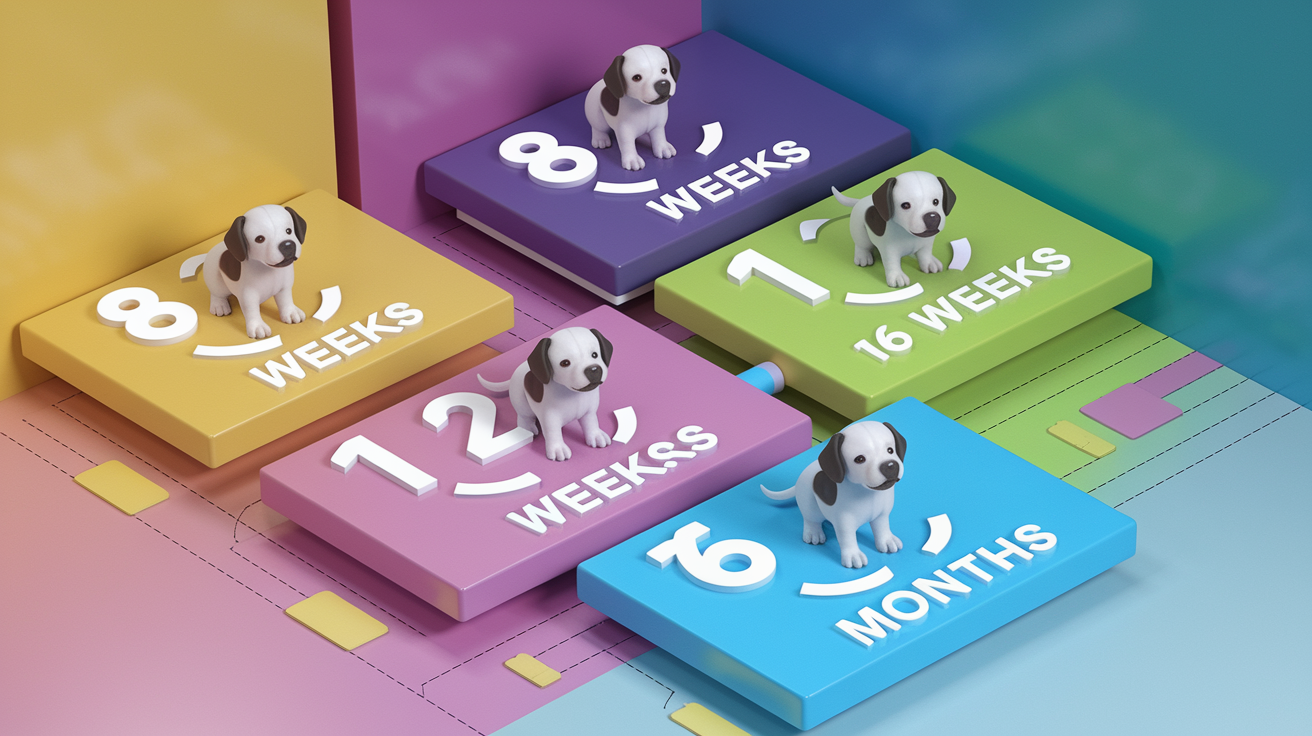
| Age Stage | Key Routine Changes |
|---|---|
| 8 weeks | Potty breaks every 1–2 hours during the day, 3–4 meals per day, naps after every activity, very short training sessions (3–5 minutes), minimal exercise, focus on safe socialization at home and bonding with primary caregiver. |
| 12 weeks | Potty intervals stretch to 2–3 hours for some pups, still 3–4 meals daily, begin short leash walks if vaccinations allow (10–15 minutes), slightly longer training sessions (5–10 minutes), continue frequent naps, expand socialization to include calm outings and new sounds. |
| 16 weeks | Many pups drop to 3 meals per day, potty breaks extend to 3–4 hours, can handle 20-minute walks or play sessions, training sessions grow to 10–15 minutes, naps still essential but may consolidate to 3–4 per day, ramp up socialization variety and start basic manners work. |
| 6 months | Most pups move to 2 meals per day, can hold bladder 5–6 hours during the day, exercise tolerance increases (25–30 minutes depending on breed), longer training sessions possible (15–20 minutes), naps reduce to 2–3 per day, solidify house training and refine loose leash walking and recall. |
As your puppy matures, bladder capacity increases, energy becomes more predictable, and focus improves during training. Gradually stretch potty intervals by 15 to 30 minutes, reduce meal frequency when your vet or breeder recommends, and extend walk or play sessions in small increments.
Don’t rush the changes. If accidents suddenly reappear or your pup seems frantic or exhausted, you’ve moved too fast. Drop back to the previous schedule for another week or two, then try again. Growth isn’t linear. Some pups leap forward at 14 weeks, others take until six months to stabilize, and that’s completely normal.
Troubleshooting and Maintaining Routine Consistency

Common schedule disruptions include middle of the night whining, random daytime accidents, sudden bursts of wild energy followed by meltdowns, refusal to settle in the crate, and erratic eating. Most of these problems trace back to inconsistent timing, skipped potty breaks, too much stimulation without enough rest, or a mismatch between the pup’s needs and the household rhythm.
If your puppy wakes at 2 AM whining, set an alarm for 1:45 and take them out before they start fussing. A quick, silent potty trip prevents the pup from practicing the whine and wait cycle. For daytime accidents, tighten your potty schedule back to every 90 minutes for a few days and watch for sniffing or circling cues you might have missed.
When a pup goes from playful to frantic and mouthy within minutes, that’s overtiredness. Skip the next play session and go straight to crate rest with a chew toy. Most pups crash within five minutes once they’re in a calm, dim space.
Consistency means keeping wake times, meal times, potty times, and nap times as predictable as possible. Even on weekends, even when visitors come over, even during the first week of a new work schedule. Puppies don’t generalize well. If Monday through Friday looks one way and Saturday is chaos, house training stalls and behavior regresses.
When life disrupts the routine (a vet appointment, a family event, a repair person in the house), return to the schedule as soon as the disruption ends. One off day won’t ruin progress, but three or four in a row will. Protect the rhythm, especially in the first three months, and your puppy will reward you with faster learning, calmer behavior, and far fewer middle of the night wake ups.
Final Words
Jump right in: use the 6am–10pm sample daily schedule as a ready template and adapt it to your pup. Follow the feeding tips, potty break timing, nap structure, short training bursts, crate sessions, and socialization steps. Adjust with the age-based changes and try the troubleshooting fixes when things wobble.
Establishing a puppy routine takes small, consistent choices each day. Start simple, keep it predictable, and you’ll get steadier days and a happier puppy.
FAQ
Q: What does a sample daily puppy schedule look like?
A: A sample daily puppy schedule is a ready-to-use template from 6am–10pm that spaces feeding, potty breaks, short naps, crate time, play, brief training, and daily socialization for steady routines.
Q: How often should I feed my puppy each day?
A: Most puppies should be fed 3–4 meals a day depending on age; consistent mealtimes help digestion and make potty timing more predictable for easier house training.
Q: How should I link feeding times to potty breaks?
A: Link feeding to potty by taking your puppy out before meals and 5–15 minutes after, plus after naps and play, to reduce accidents and build a reliable pattern.
Q: How often do puppies need potty breaks?
A: Puppies generally need potty breaks every 1–2 hours; a guideline is age in months plus one hour for hold time, and always after activity, meals, or naps.
Q: How much do puppies sleep and when should they nap?
A: Puppies typically sleep 18–20 hours daily; schedule naps after play, training, or meals in a quiet, dim space so they recharge and learn better.
Q: How long should play and exercise sessions be?
A: Play and exercise should be short bursts—several 5–15 minute sessions spread through the day—to use energy safely and protect growing joints.
Q: How do I use crate time in the routine?
A: Use crate time as short, positive periods for naps and calm breaks; build duration gradually, tie sessions to potty breaks, and keep bedtime consistent for house training.
Q: How can I socialize my puppy daily and when is the key window?
A: Socialize your puppy daily during the 8–16 week window with gentle, positive exposures to people, sounds, surfaces, other vaccinated pets, car rides, and handling.
Q: When and how should I change the routine as my puppy gets older?
A: Change routines at 8, 12, 16 weeks and 6 months by reducing meal frequency, lengthening potty intervals, increasing safe exercise, and extending training time as stamina grows.
Q: What should I do about common routine problems like night waking or accidents?
A: For night waking or accidents, tighten schedules, add a pre-bed potty, reduce late meals, ensure naps, and see a vet if issues continue or include blood, pain, or severe lethargy.
Q: When should I call the vet about potty or behavior issues?
A: Call your vet if potty problems include blood, straining, inability to urinate, or if behavior shows sudden collapse, repeated vomiting, severe pain, or extreme lethargy.